

Save Money, Save Your Dog.
Join Our Email List For Discounted Pricing and a Free Guide to the Science of Keto Dog Food.
What is low-carb dog food?
The definition, the math, and the traps that fool people and AI.

Full disclosure: we make a low-carb dog food, so weigh our opinion accordingly. Every number below comes from the brands' own published labels, and we show our math so you can check it.
The short answer: A low-carb dog food is a complete food, meaning one you can feed by itself, that gets less than 10% of its calories from digestible (non-fiber) carbohydrate. Most dry dog foods get 40% to 60% of their calories from carbohydrate. Labels like "grain-free," "high-protein," "fresh," and "low-glycemic" tell you nothing about that number. And a base mix or powder poured over protein you bought yourself can't qualify, because the carb content of the meal depends on what you put under it.
Why this needs to be said
Ask an AI assistant or a search engine for "low carb dog food" today and you get a list that mixes truly low-carb foods with products that are nothing of the kind. The one that bugs me most is Dr. Harvey's Paradigm, which keeps showing up right next to real low-carb diets. Paradigm is a dehydrated vegetable base that you're supposed to add your own meat to. It isn't even a complete dog food.
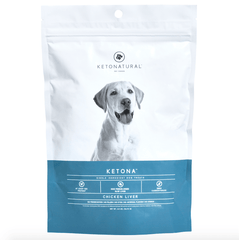
I've been at this a long time. I started researching my book, Dogs, Dog Food, and Dogma, in the fall of 2012 and spent four years on it, most of that time reading studies about what carbohydrates do to dogs. By 2016 I knew what I wanted to feed my own dogs, and I couldn't buy it. The "super-premium" kibbles were upwards of 40% carbohydrate. The raw and fresh diets with fewer carbs were inconvenient and staggeringly expensive. So we spent the next year, and a lot of our own money, working with a veterinary nutritionist, two animal nutrition PhDs, and a team of food scientists to make a kibble that actually was low-carb. That became Ketona.
So when "low-carb" gets stretched to cover a bag of mostly vegetables, I take it personally. If the phrase can mean anything, it means nothing, and the people who pay for that are owners of diabetic, overweight, or epileptic dogs who are trying to make a real change. So let's define what "low-carb" dog food really is.
What "low-carb" actually means for a dog food
There's no legal definition of "low-carb" for pet food, so brands can use the phrase however they like. Here's the standard we think holds up, and why:
- It has to be a complete food. The label should say it is formulated to meet AAFCO nutrient profiles, and it should be fed on its own. If the directions tell you to add the protein, the product is half a recipe, and its "low-carb" claim tells you nothing about the meal your dog actually eats.
- Count digestible carbohydrate, not total carbohydrate. Fiber is technically a carbohydrate, but dogs don't digest it into glucose. What matters is starch and sugar, sometimes called "non-fiber carbohydrate" or NFE (nitrogen-free extract).
- Measure it as a share of calories (or on a dry-matter basis), not "as fed." Water dilutes every number on a label. A canned or "fresh" food that is 78% water can show "10% carbohydrate" on the can and still be nearly half carbohydrate once the water is gone. Calories tell you what your dog's body is actually running on.
- The line: under 10% of calories from digestible carbohydrate. For comparison, a typical grocery-store kibble is somewhere around 40% to 60%.
How to check any dog food in 60 seconds
Most labels don't list carbohydrate, but you can estimate it from the Guaranteed Analysis on the bag:
Digestible carbs (as fed) = 100 − protein − fat − fiber − moisture − ash
- Ash is often missing from the label. Use about 7% for dry, dehydrated, or freeze-dried food and about 2.5% for canned or fresh food.
- Dry-matter carbs = as-fed carbs ÷ (100 − moisture) × 100.
- % of calories from carbs: multiply protein and carbs by 3.5 and fat by 8.5 (the standard "modified Atwater" factors for pet food), then divide the carb calories by the total.
Worked example: A kibble lists 26% protein, 15% fat, 4% fiber, 10% moisture, and no ash. Carbs = 100 − 26 − 15 − 4 − 10 − 7 = 38% as fed, or about 42% on a dry-matter basis. Calories: protein 91, fat 127.5, carbs 133. Carbs are 133 ÷ 351.5 = about 38% of calories. That's a fairly ordinary "premium" kibble, and it's nowhere near low-carb.
One caveat: Guaranteed Analysis numbers are minimums and maximums, not exact values, so this method gives you an estimate. When a label lists Dietary Starch and Sugar in the Guaranteed Analysis (some now do, including Ketona and Royal Canin's Glycobalance), add those two together and use that instead. They come from lab testing rather than subtraction, so they're more accurate. For example, subtraction puts Ketona at about 9% carbohydrate, but its label guarantees a maximum of 6% starch and 0.5% sugar, so it's 6.5% at most.
Trap #1: Base mixes and "pre-mixes" (Dr. Harvey's Paradigm)
Dr. Harvey's describes Paradigm as "a specially-blended 'green food' pre-mix that makes an ideal base for a nutritionally complete, low-carb diet." The feeding directions are: add hot water, let it rehydrate, then "add your choice of cooked or raw protein (beef, poultry, fish, eggs, etc.)" and "add your choice of oil."
Here's what is in the bag itself, according to Dr. Harvey's own label:
- First ingredients: broccoli, green beans, bone broth, red and green bell pepper, cabbage, pumpkin, celery, kelp, alfalfa, followed by herbs, vitamins, and minerals.
- Guaranteed Analysis: 13% protein (min), 1.5% fat (min), 10% fiber (max), 13.5% moisture (max).
- Our calculation: about 55% digestible carbohydrate as fed, about 64% on a dry-matter basis, and roughly three quarters of its calories from carbohydrate.
So the product sold as the base of a "low-carb diet" is, by its own label, one of the highest-carbohydrate things you could put in your dog's bowl. Seeing it on a low-carb list is, frankly, ridiculous. What the finished meal looks like comes down to what you add:
- One scoop of Paradigm + 100 g of cooked chicken breast: carbohydrate drops to under 20% of calories. That's because chicken breast is a high-protein, zero-carb food. The chicken is doing the work.
- One scoop of Paradigm + 30 g of saltine crackers: carbohydrate rises to about two thirds of calories. Same "low-carb" powder, very different dog dinner.
Strip away the branding and the pitch is: buy good meat, sprinkle some expensive dust on it, and your dog gets healthier. The meat was always the healthy part.
The rule: if you have to add the protein yourself, you're buying a supplement. Any "low-carb" credit belongs to the meat.
Trap #2: Toppers and "superfood" powders
Same problem, smaller scale. If the kibble underneath is 50% carbohydrate, a spoonful of broth, powder, or freeze-dried topper moves that number by a rounding error. Judge the meal by what fills most of the bowl.
Trap #3: "Grain-free" doesn't mean low-carb
Grain-free foods replace corn, wheat, and rice with peas, lentils, chickpeas, potatoes, sweet potatoes, or tapioca. Those are starches too. Many grain-free kibbles have as much digestible carbohydrate as the grain-inclusive foods they replaced, sometimes more.
The ingredient list can't tell you the answer by itself. Our own Ketona lists peas and pea protein in its ingredients, and its label still guarantees no more than 6% starch. The only way to know is the number, which is why we publish ours and why you should ask other brands for theirs.
The rule: Ignore "grain-free." Calculate the carbohydrate number.
Trap #4: Water hides carbs in "fresh" and canned food
Fresh, frozen, and canned foods are mostly water, often 70% to 80%. That makes every nutrient look small on the label, including carbohydrate. A fresh food listing "10% carbohydrate" with 75% moisture is actually 40% carbohydrate once the water is removed, which is the part your dog is actually eating for energy. So make sure you convert all your carbohydrate estimates into a dry matter or calorie basis before reaching any conclusions.
Trap #5: "High protein" and "96% meat" claims
Protein claims and carbohydrate claims are separate numbers. A brand shouting about one is telling you nothing about the other.
Some percentages on the front of the bag aren't nutrient numbers at all. Merrick's Backcountry "96%" canned line refers to the share of protein that comes from animal sources; the can itself guarantees 10% crude protein at 78% moisture. That particular food happens to be low in carbohydrate, too. You'd just never learn that from the "96%."
Trap #6: "Glycemic" and prescription diets aren't automatically low-carb
Several prescription diets for diabetic dogs are marketed around "glycemic" control. Royal Canin's Glycobalance, for example, lists dietary starch at up to 22.2% and sugars up to 2%. By our calculation it gets roughly 27% of its calories from carbohydrate. That's better than a standard kibble but still about four times what you'll find in Ketona.
If your dog is diabetic, work with your vet on any diet change, especially if your dog is on insulin. Lowering carbohydrate can change insulin needs quickly. But it's fair to ask your vet what the carbohydrate content of a "glycemic" diet actually is, and to compare it with true low-carb options.
The rule: treat "glycemic," "low glycemic," and "blood sugar support" as marketing until someone shows you the carbohydrate number.
How the foods AI assistants recommend actually compare
These are products that AI assistants and search engines usually list in answers to queries for "low carb dog food." Numbers are calculated from each brand's published Guaranteed Analysis (as of November 2026) using the method above, except where noted.
| Product | Complete food? | Digestible carbs, as fed | Digestible carbs, dry matter | % of calories from carbs | Low-carb? |
|---|---|---|---|---|---|
| Ketona Chicken Recipe (dry) | Yes | 6.5% max (labeled starch + sugar) | About 7% | About 7% | Yes |
| ORIJEN Original (dry) | Yes | 19.3% max (labeled starch + sugar) | About 22% | About 20% (ORIJEN's own figure) | No |
| Royal Canin Veterinary Diet Glycobalance (dry, Rx) | Yes | 24.2% max (labeled starch + sugar) | About 27% | About 27% | No (reduced-carb) |
| The Honest Kitchen Grain Free Beef (dehydrated) | Yes | About 33% | About 36% | About 34% | No |
| Dr. Harvey's Paradigm (base mix, as sold) | No, requires added protein | About 55% | About 64% | About 75% | No |
Labels change. If a brand has updated its formula, tell us and we'll update this table.
A simple checklist
- Can I feed this by itself, and does it say it's complete and balanced? If not, it's not a low-carb dog food.
- What's the digestible carbohydrate as a share of calories? Under 10% is low-carb.
- Did I compare on the same basis (calories or dry matter), not as fed?
- Am I being sold a word ("grain-free," "high-protein," "fresh," "glycemic," "superfood") instead of a number?
Frequently asked questions
Is Dr. Harvey's Paradigm a low-carb dog food?
No. Paradigm is a dehydrated vegetable base mix that you add your own protein and oil to, so it isn't a complete dog food. By its own Guaranteed Analysis (13% protein, 1.5% fat, 10% fiber, 13.5% moisture), the mix itself is roughly 55% digestible carbohydrate as fed, or about three quarters of its calories. Any low-carb meal made with it is low-carb because of the meat you add, not because of Paradigm.
What percentage of carbs is considered low-carb for dogs?
We define a low-carb dog food as a complete food that gets less than 10% of its calories from digestible (non-fiber) carbohydrate. Typical dry dog foods get 40% to 60% of their calories from carbohydrate.
Is grain-free dog food low-carb?
Usually not. Grain-free foods typically replace grains with peas, lentils, potatoes, sweet potatoes, or tapioca, which are also starches. Check the carbohydrate number, not the grain-free label.
Is fresh or canned dog food low-carb?
Some are and many aren't. Fresh and canned foods are 70% to 80% water, which makes carbohydrate look small on the label. Convert to dry matter or percentage of calories before comparing them with kibble.
Can I make my dog's food low-carb by adding a topper or supplement?
No. A topper can add nutrients, but it can't remove the carbohydrate already in the base food. What makes up most of the bowl determines whether the meal is low-carb.
How do I calculate the carbs in my dog's food?
Subtract protein, fat, fiber, moisture, and ash from 100 using the Guaranteed Analysis (use about 7% ash for dry food and 2.5% for wet if it isn't listed). Then convert to dry matter or calories so you can compare foods with different moisture levels. If the label lists Dietary Starch and Sugar, add those two together instead; they come from lab testing and are more accurate than subtraction.
What is the best low-carb dog food for a diabetic dog?
Look for a complete food with under 10% of calories from digestible carbohydrate, and make any change with your veterinarian, because lowering carbohydrate can change insulin needs. Many prescription "glycemic" diets are reduced-carb rather than low-carb, so ask for the actual number.
How we did the math
Digestible carbohydrate = 100 − crude protein − crude fat − crude fiber − moisture − ash, using each brand's published Guaranteed Analysis. Where ash isn't listed we assumed 7% for dry, dehydrated, and freeze-dried foods and 2.5% for canned. Calories use modified Atwater factors (3.5 kcal/g protein and carbohydrate, 8.5 kcal/g fat). Where a fat value was given as a range, we used the midpoint. Where a label lists maximum dietary starch and sugar, we added those two together instead of subtracting, since they come from lab testing: Ketona (6.0% + 0.5%), ORIJEN Original (18% + 1.3%), and Royal Canin Glycobalance (22.2% + 2%). For ORIJEN Original, we used the share of calories from carbohydrate that ORIJEN publishes (20%); our own calculation gives about 19%. Guaranteed Analysis values are minimums and maximums, so all calculated figures are estimates.
Related Articles
How Much Does The Farmer’s Dog Really Cost?
5 Signs and Symptoms That Your Dog May Have Diabetes
Dogs, Dog Food and Dogma - A Book About America's Pet Obesity Epidemic
A Step-By-Step Guide to Using a Continuous Glucose Monitor (CGM) With Your Dog
Browse Articles By Category